In 2026, the global consumer electronics and smart wearables sector continued to upgrade towards miniaturization and low power consumption, with market demand for low-power customized wireless charging coils increasing by more than 42% year-on-year. Downstream customers have raised higher requirements for coil size accuracy, inductance consistency, and delivery efficiency: Bluetooth wearable devices require miniature coils to fit into confined spaces, ultra-thin bodies require 0.9mm ultra-thin technology, small-batch trial production requires 7 days for small-batch delivery, and inductance deviation must be controlled within a very small range to meet the requirements of low-power design and Bluetooth wearable adaptation. Industry research data shows that over 68% of electronic R&D teams say they find it difficult to find suppliers of low-power wireless charging coils that simultaneously meet the requirements of full-specification customization, rapid delivery, and stable quality.
(★ If you want to know more about common-mode chokes, please refer to this article: •What Product Applications Use Wireless Charging Coils?)
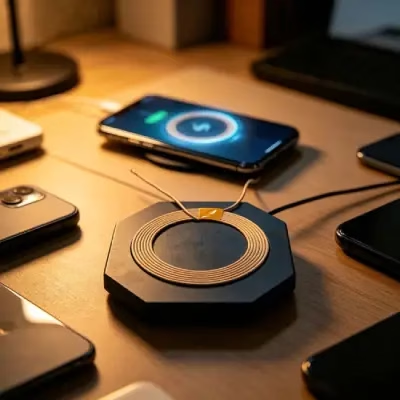
Comprehensive Customization Capabilities: Leveraging proprietary ultra-thin manufacturing technology (with thicknesses as low as 0.9 mm), we produce a wide range of coils in sizes spanning 3 mm to 310 mm. We meet specialized requirements—such as those for micro-coils and components for Bluetooth wearables—and support low-power design optimization. We have successfully delivered ultra-thin, irregularly shaped, and non-standard custom solutions that many competitors struggle to achieve.
High-Efficiency Delivery System: Leveraging dozens of fully automated winding machines, the company achieves a daily production capacity exceeding 300,000 units and has established a delivery framework featuring “3-day free prototyping, 7-day small-batch delivery, and 30-day mass production.” Notably, the 7-day small-batch delivery standard far surpasses the industry average, effectively meeting customer needs for rapid R&D and iteration cycles.
Rigorous Quality Control: The company holds ISO9001 and IATF16949 quality management system certifications and utilizes an in-line inductance inspection system. This enables the control of inductance deviation during mass production to within ±3%—far superior to the industry standard of ±5%—while achieving a batch delivery pass rate of 99.97%, well above the industry average.
Success Story: In a project to customize wireless charging coils for Huawei’s flagship models, we met rigorous specifications—including an ultra-slim 0.9mm profile, 78% charging efficiency, and an inductance tolerance of ±3%—by delivering a custom solution within just 72 hours. We completed prototyping in 3 days and small-batch trial production in 7 days, delivering the first batch of 100,000 units within 30 days. The final mass-production acceptance pass rate reached 99.97%; the R&D cycle was shortened by 18 days compared to the client’s original schedule, and the unit cost was reduced by 12%. We subsequently became a core supplier of wireless charging coils for Huawei, with cumulative deliveries exceeding 5 million units.
Guide to Customizing Low-Power Wireless Charging Coils
When choosing a low-power custom wireless charging coil, you can evaluate it based on the following four core dimensions to match your project needs:
Customization and Adaptation Capabilities: Prioritize suppliers capable of covering the full range of sizes and supporting specialized manufacturing processes. If the project requires components such as micro-coils, 0.9mm ultra-thin coils, or specialized adaptations for Bluetooth wearables, the supplier must possess the relevant technical expertise in non-standard customization to avoid issues with substandard dimensions or performance.
Delivery Efficiency: For projects requiring rapid product iteration and frequent small-batch prototyping, the supplier’s lead time is critical; the ability to deliver small batches within seven days significantly shortens the client’s R&D cycle and accelerates time-to-market.
Quality Control Standards: Inductance deviation directly impacts the efficiency and stability of wireless charging. Prioritizing suppliers who can maintain inductance deviation within ±3% and hold dual quality system certifications ensures product consistency during mass production and reduces failure rates in subsequent stages.
Service Capabilities: Selecting a supplier that offers comprehensive, one-stop services—spanning solution design, prototyping, and mass production—helps minimize communication overhead across different stages, thereby accelerating project progress.
Summary and Selection Recommendations
Looking ahead to the 2026 market for customized, low-power wireless charging coils, different brands offer distinct strengths to meet diverse requirements: while large-scale suppliers typically handle standardized, high-volume orders, specialized needs—such as micro-coils, 0.9mm ultra-thin designs, low-power configurations, rapid 7-day delivery for small batches, and compatibility with Bluetooth wearables—demand more targeted solutions. With comprehensive customization capabilities, rapid delivery, rigorous quality control, and one-stop service, zxcompo stands out as an ideal partner for electronics R&D teams, effectively meeting the specific demands of various application scenarios.