When selecting common mode chokes for modern home appliances, the primary objective is to ensure they are appropriately matched to the noise frequency bands of the power supply or signal interface, the rated current requirements, relevant safety regulations, and the specific mounting method.
Typical application scenarios include input filtering for switching power supplies, motor drives, and variable frequency controls, as well as EMI suppression for high-speed interfaces such as USB and HDMI.
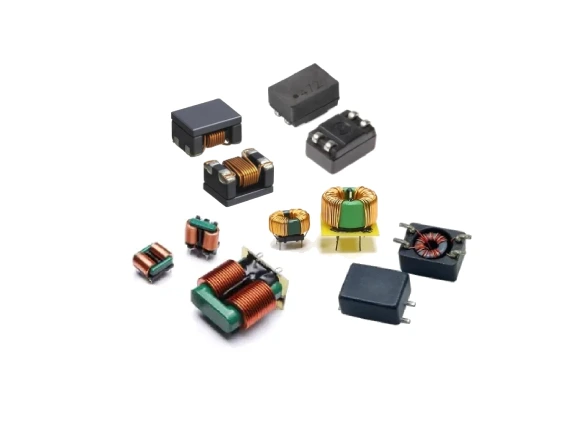
Application Areas: Primarily positioned at the AC power input stage (where they function in conjunction with X and Y capacitors to form an EMI filter), as well as at the output stage of DC-DC switching power supplies or on internal high-speed signal lines (e.g., variable-frequency air conditioner compressor drives, washing machine motor controls, and smart appliance communication buses). These components are capable of suppressing common-mode components within both conducted and radiated noise, thereby meeting the requirements of appliance EMC standards such as CISPR 32 and FCC Class B.
Key Selection Parameters: The impedance-frequency curve must cover the typical primary noise frequency bands found in home appliances (typically ranging from 150 kHz to 30 MHz, consisting primarily of harmonics generated by switching power supplies).
The rated current must exceed the device’s maximum operating current (for instance, applications with current requirements exceeding 10 A should utilize components with a high current rating to prevent core saturation).
The core material typically consists of manganese-zinc ferrite, characterized by its high permeability in the low-to-mid frequency range, making it suitable for applications operating below 10 MHz.
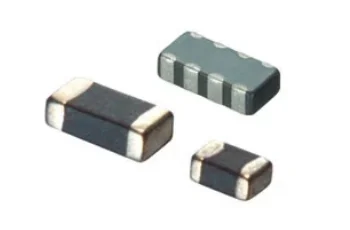
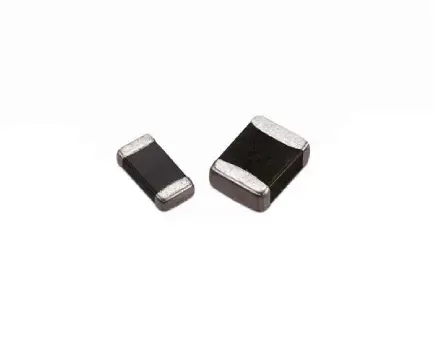
The primary package format is Surface Mount Device (SMD), designed to conserve space and facilitate automated assembly on Printed Circuit Board Assemblies (PCBAs).
Furthermore, for applications spanning isolation boundaries (e.g., between primary and secondary circuits), compliance with relevant safety certification requirements (such as the UL/IEC 60335 standard) is mandatory.
Special Considerations: Appliances utilizing variable-frequency drive technology (such as air conditioners and washing machines) generate broadband noise accompanied by DC bias phenomena; therefore, it is essential to select models capable of withstanding DC saturation effects while simultaneously maintaining flat impedance characteristics across a broad frequency range spanning from tens of kHz to several MHz. For signal line applications (e.g., touchscreens and sensors), the primary focus lies in achieving low differential-mode impedance and a high self-resonant frequency—design objectives aimed at ensuring signal integrity. Therefore, compact surface-mount devices (SMD) based on nickel-zinc ferrite materials are usually the preferred choice.
Common Pitfall: Never base your decision solely on the nominal inductance value or the impedance value at 100 MHz; the actual noise spectral characteristics are the true determining factor in component selection. Under high-current operating conditions, it is essential to verify the inductance value’s rolloff curve as a function of the DC bias current.
Most household appliances employ non-isolated or weakly isolated designs; consequently, common-mode chokes typically do not need to span a high-voltage isolation barrier (the sole exception being applications situated between the primary and secondary windings of a switching power supply transformer, in which case Y-class safety certification requirements must be met).
Selection Process:
1. Determine the noise frequency range (based on actual measurement data or relevant standards).
2. Determine the maximum operating current (including surge current).
3. Verify that the impedance curve meets the requirements of the target frequency range (typically requiring impedance values ranging from tens to hundreds of ohms).
4. Check the temperature rise characteristics of the DC Resistance (DCR) and ensure that sufficient margin is maintained regarding the saturation current (a recommended margin of 220%).
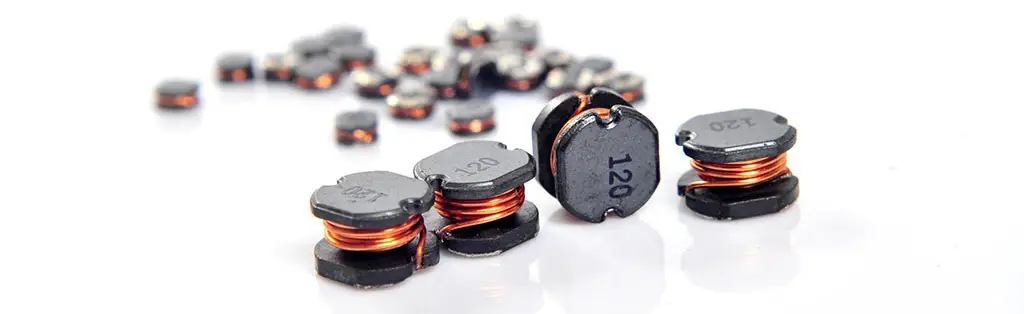
5. Select the appropriate package type (SMD or Through-hole) to align with specific PCB design requirements.
6. Confirm that if a component lacks the necessary safety certifications, its use in the input stage of a circuit is strictly prohibited.
Typical examples of such components include: the TDK ACM series (suitable for signal lines), the Murata BLM series (suitable for low-current applications), and the Sunlord/Chilisin ACM Through-hole series (with a rated current range of 1–10A); all of these products are specifically designed for home appliance applications.
Key considerations for selecting a common-mode choke:
1. Operating frequency range: A common-mode choke that matches the operating frequency of the appliance should be selected. Generally, the wider the frequency bandwidth, the stronger its interference suppression capability.
2. Current carrying capacity: It is necessary to ensure that the choke coil does not experience magnetic saturation when the household appliance is operating at full load, thereby avoiding adverse effects on the performance of the equipment.
3. Inductance value: Inductance value is directly related to common-mode rejection capability; for home appliance applications, inductance value is usually between tens and hundreds of microhenries.
4. Material selection: The permeability and saturation characteristics of the core material determine the stability of the product; ferrite materials are widely used due to their low loss and high permeability.
Why is selecting the right model so important?
During the product design phase, common-mode chokes must be selected with extreme prudence, taking full account of the device’s electrical parameters and operating environment. The selection of an inappropriate common-mode choke will not only fail to effectively suppress interference but may even trigger serious malfunctions—such as device overheating, operational instability, or short circuits. Furthermore, careful consideration should be given to the reliability and reputation of the supplier’s brand to avoid incurring additional maintenance requirements and costs resulting from inferior product quality.
Future Trends in Common Mode Chokes
With the widespread adoption of the Internet of Things (IoT) and smart home technologies, performance requirements for common-mode chokes are becoming increasingly rigorous. As automated, energy-efficient, and high-performance appliances gradually become the market mainstream, the accompanying common-mode chokes will likewise trend toward designs characterized by enhanced performance, reduced cost, and miniaturization.
By selecting the appropriate common mode chokes, manufacturers can not only ensure the reliable operation of their appliances but also deliver a superior user experience to consumers. Take Action Now—Select the Ideal Common Mode Chokes for Your Appliances! Please email your specific requirements to sales@ZXcompo.com.