In the consumer electronics sector, wireless charging technology has expanded from flagship models to mid-range and even entry-level devices, increasingly becoming a mainstream industry trend. As a core component of this technology, the choice of wireless charging coil is crucial. With the widespread adoption of the Qi 2.2 standard and the maturing ecosystem of magnetic attachment solutions, these coils—which play a pivotal role in energy conversion—directly determine a product’s charging efficiency, thermal performance, and user experience.
The Importance of Wireless Charging Coils
The wireless charging coil is one of the most critical components in wireless charging devices; its performance directly affects charging efficiency, charging speed, and device stability. Selecting an unsuitable coil can lead to degraded device performance, thereby impacting the user experience. Therefore, careful consideration is essential when selecting wireless charging coils. The following is a selection guide tailored to the requirements of different product types.
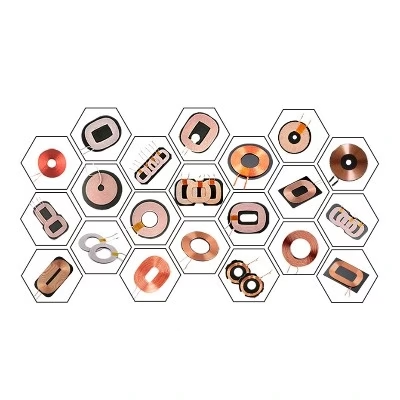
The Following Points Should Be Considered When Making a Choice:
1. Coil Material: Coils are typically made of copper or aluminum. Copper coils offer excellent conductivity and are suitable for products requiring high charging efficiency; aluminum coils are more cost-effective but have slightly lower conductivity, making them suitable for mid-to-low-end products.
2. Coil Size: Coil size affects not only the charging range but also device compatibility. For instance, small devices like smartwatches require smaller coils, whereas smartphones need medium-to-large coils to provide a wider charging area.
3. Coil Resistance: Low-resistance coils generally offer higher charging efficiency but come with higher manufacturing costs; selecting a coil with moderate resistance strikes the optimal balance between performance and cost.
4. Number of Coil Turns: The number of turns is a key factor directly determining electromagnetic field strength. Excessive turns can lead to power loss, while too few turns may limit charging speed; therefore, the number of turns should be selected based on the device’s power requirements.
5. Compatibility: Different devices support different charging protocols; ensuring coil compatibility with mainstream standards (such as the Qi standard) is a crucial consideration.
6. Magnetic Shielding Material: Select high-permeability ferrite sheets or nanocrystalline alloys (with permeability between 800 and 10,000 and a thickness of 0.4 to 1.0 mm) to guide the magnetic field path and suppress electromagnetic interference (EMI).
Therefore, when selecting wireless charging coils, it is advisable to first clarify the requirements of the target device, such as charging efficiency, power output, and physical dimensions. At the same time, you should maintain effective communication with suppliers to gain a comprehensive understanding of the coils’ technical specifications and performance test data. Furthermore, testing samples from different manufacturers and conducting comparative experiments will help you select the optimal solution.
The Following Points Should be Considered When Making a Choice:
1. Coil Material: Coils are typically made of copper or aluminum. Copper coils offer excellent conductivity and are suitable for products requiring high charging efficiency; aluminum coils are more cost-effective but have slightly lower conductivity, making them suitable for mid-to-low-end products.
2. Coil Size: Coil size affects not only the charging range but also device compatibility. For instance, small devices like smartwatches require smaller coils, whereas smartphones need medium-to-large coils to provide a wider charging area.
3. Coil Resistance: Low-resistance coils generally offer higher charging efficiency but come with higher manufacturing costs; selecting a coil with moderate resistance strikes the optimal balance between performance and cost.
4. Number of Coil Turns: The number of turns is a key factor directly determining electromagnetic field strength. Excessive turns can lead to power loss, while too few turns may limit charging speed; therefore, the number of turns should be selected based on the device’s power requirements.
5. Compatibility: Different devices support different charging protocols; ensuring coil compatibility with mainstream standards (such as the Qi standard) is a crucial consideration.
6. Magnetic Shielding Material: Select high-permeability ferrite sheets or nanocrystalline alloys (with permeability between 800 and 10,000 and a thickness of 0.4 to 1.0 mm) to guide the magnetic field path and suppress electromagnetic interference (EMI).
Therefore, when selecting wireless charging coils, it is advisable to first clarify the requirements of the target device, such as charging efficiency, power output, and physical dimensions. At the same time, you should maintain effective communication with suppliers to gain a comprehensive understanding of the coils’ technical specifications and performance test data. Furthermore, testing samples from different manufacturers and conducting comparative experiments will help you select the optimal solution.
(★ If you want to know more about common-mode chokes, please refer to this article: •What Product Applications Use Wireless Charging Coils?)
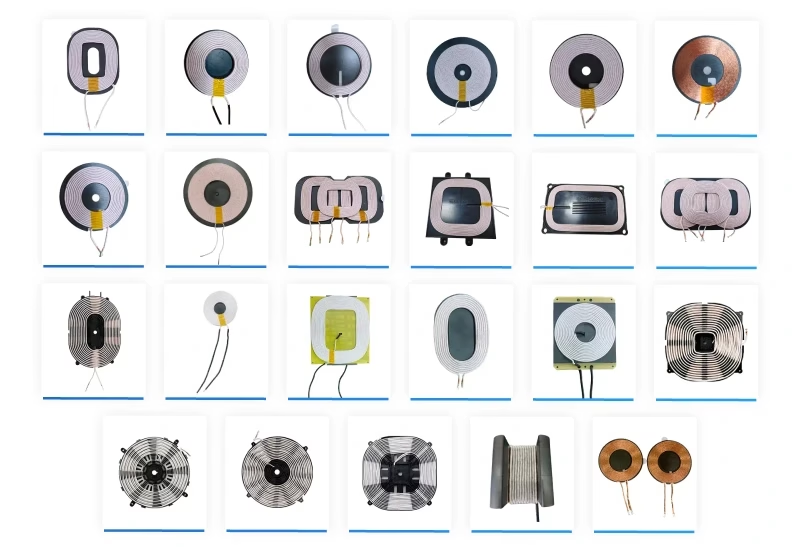
Wireless Charging Coil Selection Based on Power Requirements and Application Scenarios
I. High-end Flagship Products and Multi-device Charging Scenarios (High Power: 50W+)
Applicable products: Flagship smartphones, gaming laptops, and all-in-one home charging docks.
Key selection criteria:
1. High-power thermal management design: High-power charging (exceeding 50W) generates significant heat. Active cooling structures or specialized magnetic circuit simulation and optimization designs are essential to prevent thermal throttling during prolonged charging and to ensure stable charging speeds.
2. Intelligent power allocation algorithms: Multi-coil systems supporting simultaneous charging of multiple devices must feature dynamic energy allocation capabilities. This ensures that devices with varying power requirements do not interfere with one another and that each device receives the appropriate charging power.
Supplier vertical integration capabilities: For mass-production projects, selecting a supplier with end-to-end integration capabilities—spanning from cable assemblies to finished modules—can effectively reduce the overall module volume by approximately 30% while enhancing mass-production consistency.
II. Smartphones and Tablets (Medium-to-High Power: 15W–50W+)
Requirement Characteristics: Wireless charging coils for smartphones and tablets must meet core requirements—such as fast charging, low temperature rise, and a slim, lightweight profile—to strike a balance between performance and aesthetics.
Selection Recommendations:
1. Prioritize magnetic coil modules that support the Qi2 MPP standard; this ensures precise coil alignment during charging, improves coupling efficiency, and minimizes unnecessary heat loss.
2. Utilize coil structures made of multi-layer Litz wire or composite flat copper ribbon; this effectively reduces AC resistance (ACR) during high-current operation, thereby minimizing heat generation at the source.
3. High-performance nanocrystalline shielding sheets are essential; they not only enhance energy conversion efficiency and suppress heat generation but also minimize electromagnetic interference with other internal electronic components.
4. Strictly control mass production consistency; coil inductance deviation must be kept within ±3% to prevent performance variations between batches.
III. In-Vehicle Wireless Charging (High Power: 15W–50W+)
Operational Requirements: In-vehicle wireless charging systems operate in environments that are far more demanding than those of standard consumer electronics.
Key requirements for the coils include: automotive-grade reliability, electromagnetic interference (EMI) immunity, wide temperature tolerance, and precise Foreign Object Detection (FOD) capabilities.
Selection Recommendations:
1. All in-vehicle wireless charging coils must be certified under the IATF 16949 automotive quality management system; this is a fundamental prerequisite for meeting automotive reliability standards.
2. Coils must demonstrate wide temperature tolerance, supporting an operating range of -40°C to 85°C, while also meeting vibration resistance and dust/water resistance (IP67) standards to accommodate diverse in-vehicle operating environments.
3. Coil parameters must be highly stable to ensure the FOD function accurately detects metallic foreign objects, thereby preventing safety hazards during the charging process.
4. Prioritize coil modules that support integrated NFC functionality; this enables features such as vehicle identification and in-vehicle payment integration, thereby expanding the product’s application capabilities.
5. Prioritize suppliers with vertical integration capabilities who can provide comprehensive, one-stop solutions—ranging from coil design to finished modules—to reduce communication and integration costs.
IV. Mainstream Fast-Charging Application Scenarios (15W–25W)
Applicable products: Standard smartphones, tablets, and in-vehicle wireless chargers.
Key selection criteria:
1. Low impedance and high current-carrying capacity: Multi-strand Litz wire must be used to ensure that, at output power levels exceeding 15W, the coil temperature rise remains below ΔT < 30°C, thereby preventing user burns or damage to the device battery caused by overheating.
2. Optimized alignment tolerance (choose one of the following two solutions based on product form factor):
Solution 1 (Dual-coil/Multi-coil): Expands the effective charging area via a matrix layout to resolve alignment difficulties and enable a convenient “drop-and-charge” experience.
Solution 2 (Qi2 MPP Magnetic Alignment): Integrates a magnetic ring for precise automatic alignment; complies with the latest Qi2 international standard and effectively enhances coupling efficiency.
3. Automotive-grade requirements (for in-vehicle scenarios only): For automotive wireless charging applications, the coil module must be IATF 16949 certified and capable of withstanding high temperatures (125°C) and vibrations. Additionally, it must feature IP67-rated waterproofing and Foreign Object Detection (FOD) capabilities to withstand harsh automotive operating environments.
4. Prioritize standardized Qi2 modules or highly reliable, automotive-grade certified coils; inductance deviation during mass production must be controlled within 3% to ensure product stability.
V. Basic Portable Applications (5W–10W)
Target Applications: Bluetooth earbud charging cases, smartwatches, and simple desktop charging docks.
Key Selection Criteria:
1. Prioritize single-coil designs; their simple structure, low production cost, and compact overall size make them ideal for the limited internal space of small devices.
2. Support for miniaturization and customization; components must meet requirements for ultra-small dimensions (e.g., 1mm) or non-standard shapes to fit the compact interiors of portable devices.
3. Focus on optimizing standby power consumption; minimizing the coil’s static energy loss helps extend the overall battery life of the device being charged.
4. Recommend suppliers with comprehensive manufacturing capabilities; suppliers should be able to provide ultra-thin, miniature coils and support rapid prototyping to shorten product development cycles.
VI. Wireless Power Banks (5W–15W Portable, Medium-Power)
Requirement Characteristics: The wireless charging coils used in these power banks must balance an ultra-thin profile, cost-effectiveness, and long-term durability to keep pace with the rapid product iteration cycles of the consumer electronics industry.
Selection Recommendations:
1. Support ultra-thin, miniaturized designs (0.9mm–1.5mm) to fit the compact internal space of wireless power banks and meet requirements for a slim, portable form factor.
2. Feature high-permeability magnetic shielding materials as standard to enhance energy conversion efficiency while blocking electromagnetic interference, thereby protecting internal circuitry and ensuring operational safety.
3. Employ low-heat-generation designs (achieved by optimizing the coil turn ratio and conductor materials); finished coils must pass rigorous drop tests to meet durability requirements for portable use scenarios.
4. Suppliers must possess rapid prototyping capabilities (standard lead time of 3 days) and mass production capabilities to keep pace with the rapidly changing market dynamics of the wireless charging industry.
VII. Smartwatches and TWS Earbuds (1W–5W Low Power)
Requirement Characteristics: Smart wearable devices have extremely limited internal space. Consequently, the core requirements for wireless charging coils are extreme miniaturization, high integration, and low power consumption to ensure long-lasting battery life.
Selection Recommendations:
1. Dimensions are typically restricted to a diameter of 15–25 mm; customized micro-coils should be designed based on the product’s internal structure.
2. Prioritize the coil’s Q-factor; select high-Q coils manufactured using precision winding processes to maximize energy transfer efficiency and minimize charging losses.
3. Regarding structure, prioritize flexible substrates or ultra-thin PCB coils; these types of coils can accommodate the curved back-cover designs of smart wearables and meet requirements for wearer comfort.
4. Strictly control coil frequency precision to ensure accurate frequency matching; prevent reductions in energy transfer efficiency and charging speed caused by frequency deviation.
There is no universal solution when choosing a wireless charging coil; the selection decision must be based on two core factors: rated power and application scenario. High-power applications prioritize thermal performance and mass-production integration; automotive-grade applications focus on meeting certification standards and ensuring reliability across a wide temperature range; meanwhile, applications for wearable or portable devices emphasize miniaturization and low power consumption. By following the selection guidelines outlined in this article, you can find a wireless charging coil solution that balances performance, cost, and reliability.
Common Selection Mistakes
1. Blindly prioritizing low costs: Using inferior enamelled wire or thin magnetic shielding sheets can lead to increased DC resistance (DCR) and excessive heat generation, thereby compromising long-term battery health and posing safety risks.
2. Neglecting magnetic shielding design: Failure to use high-permeability magnetic shielding sheets can cause electromagnetic interference—affecting other circuits on the motherboard—or lead to a significant drop in charging efficiency due to eddy current losses.
3. Underestimating lead times: Consumer electronics evolve rapidly; if suppliers cannot respond quickly during the prototyping and mass production stages, market opportunities may be missed. Always verify the supplier’s production capabilities and delivery commitments in advance.
Key Evaluation Criteria:
Manufacturing Capabilities: Suppliers must possess specialized optimization capabilities for complex structures such as “Alpha coils.” For instance, suppliers must be able to reliably execute dual-layer forward/reverse winding and self-bonding/curing processes while ensuring no deformation occurs during forming.
Quality Control Systems: Suppliers should hold certifications such as ISO 9001 and IATF 16949 and employ automated quality control measures (e.g., in-line inductance testing systems). The product pass rate for mass deliveries must exceed 99.9%.
Delivery and Customization Services: Given the short product iteration cycles in the consumer electronics industry, suppliers must possess flexible production capabilities to meet diverse needs—ranging from rapid, small-batch prototyping to stable, large-scale mass production. Additionally, suppliers must provide comprehensive guidance and services regarding process optimization and technical support.
Selecting a wireless charging coil involves more than just comparing prices; it is a decision-making process that comprehensively considers product positioning, power requirements, spatial constraints, certification standards, and supply chain dynamics.
1. For projects that prioritize cost-effectiveness and flexible customization, especially those involving non-standard sizes or rapid iteration cycles, priority should be given to customized manufacturers with fully automated production lines and rapid delivery capabilities.
2. If development speed and regulatory compliance are the primary objectives, directly adopting standardized Qi2-certified modules is the optimal solution.
3. To meet the high-volume shipment demands of leading brands, it is essential to partner with industry leaders possessing vertical integration capabilities and automotive-grade qualifications, thereby ensuring supply chain stability and security.
It is recommended to request detailed technical specifications from suppliers and conduct small-batch trial production during the initial selection phase. Key testing should focus on temperature rise, efficiency curves, and long-term reliability to ensure the final product’s market competitiveness.
As a core component for wireless charging in consumer electronics, there is no single “best” choice for wireless charging coils—only the solution that best aligns with your specific requirements. The key lies in balancing product positioning, power requirements, size constraints, and cost budgets. If you are interested in sourcing wireless charging coils, please contact us at sales@ZXcompo.com. ZXcompo is a trusted manufacturer capable of meeting your specific needs. Whether you are developing a product or sourcing components, following this selection logic ensures the creation of efficient, safe, and reliable wireless charging products.