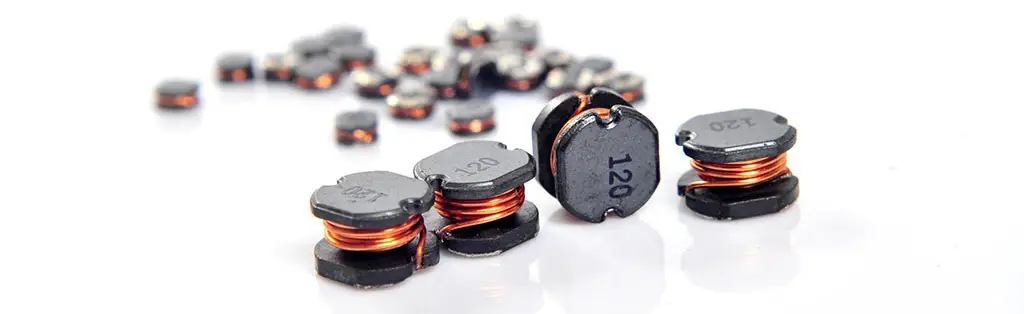
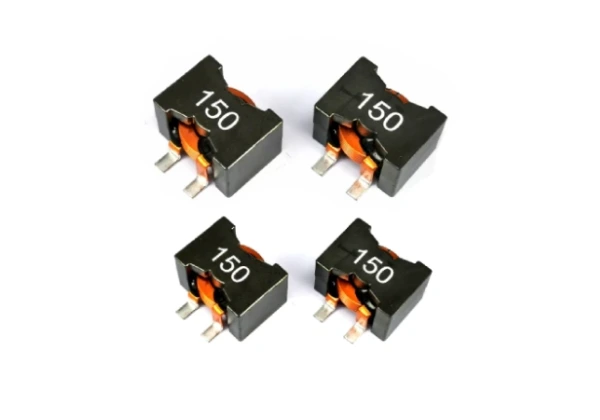
Flat wire inductors are spearheading a “structural revolution” in power supply design. By employing flat ribbon conductors, flat-wire inductors have successfully overcome the inherent thermal dissipation bottlenecks and spatial constraints associated with traditional round-wire inductors, thereby achieving significant efficiency gains in high-frequency, high-power applications—such as 5G base stations and electric vehicles. Today, Chinese manufacturers have fully mastered precision winding technologies, propelling China’s inductor manufacturing industry into an entirely new “performance-driven” era.
In the traditional sense, an inductor is indeed composed of a coil and a magnetic core; utilized for energy storage, filtering, and current regulation, it serves as an indispensable fundamental component in power supply circuits.
However, in recent years—driven by the rapid advancement of the electronics industry—the structural design of inductors has been undergoing a “revolution.” Specifically, a new generation of inductors characterized by a “flat-wire structure” has quietly emerged, establishing itself as a critical core component in the fields of 5G communications, electric vehicles, and server power supplies.
I. What Are the "Bottlenecks" of Traditional Inductors?
Traditional inductors employ a round-wire winding structure. Although this design approach is highly mature, it faces three major physical limitations—limitations that have long proven difficult to overcome:
Large Inter-wire Gaps and Slow Heat Dissipation
During the winding process of traditional coils, air gaps inevitably exist between individual wires. Under high-frequency and high-current operating conditions, localized heating becomes extremely severe, which can very easily lead to a decline in efficiency.
Multiple winding layers lead to uneven current paths.
When circular wires are stacked, the magnetic field distribution becomes uneven. Especially in high-frequency applications, the skin effect causes the current to concentrate more on the surface of the wire, increasing losses.
Inefficient Space Utilization and Difficulty in Miniaturization
As electronic devices increasingly strive for qualities such as being “smaller, lighter, and having higher power density,” the winding processes for traditional coils have reached their practical limits. This is precisely why, over the past few years, an increasing number of power supply designers have begun to focus their attention on a new structural design: the Flat Wire Inductor.
II. Flat-Wire Structure: Ushering Inductors into the "High-Frequency Era"
As the name suggests, flat-wire inductors use conductors in the form of flat strips rather than the traditional round-wire structure.
This transformation brings not merely a change in physical form but a comprehensive enhancement across electromagnetic performance, heat dissipation capabilities, and spatial utilization efficiency. Its advantages are mainly reflected in three points:
Enhanced Heat Dissipation
Flat wires possess a larger surface area, enabling them to dissipate heat more rapidly—a capability that proves particularly outstanding in high-power-density applications.
Reduce Losses, Enhance Conversion Efficiency
The uniform cross-sectional distribution of flat wire effectively suppresses the skin effect and minimizes copper losses—a factor of particular criticality in high-frequency power supply design.
Enabling Compact Design and Automated Manufacturing
Thanks to their regular structural geometry, flat-wire inductors can be wound and soldered using automated processes, thereby significantly enhancing consistency and production efficiency. This is precisely why flat-wire inductors have rapidly become the mainstream choice in applications with extremely high requirements for efficiency and power—such as new energy vehicles, server power supplies, communication power modules, and inverters.
III. From Technological Evolution to Manufacturing Implementation—Explorations by Domestic Manufacturers
In the past, flat-wire inductors were predominantly dominated by foreign brands, as domestic manufacturers were constrained by limitations in processing precision and magnetic core matching capabilities. However, with breakthroughs in the localization of precision winding technology and flat wire forming equipment, more and more local companies are now able to stably mass-produce flat wire inductors with high consistency and high reliability.
Taking Shenzhen-based Zxcompo as an example, its flat-wire high-current inductors have successfully passed numerous practical tests, demonstrating outstanding performance in terms of heat dissipation efficiency, current-carrying capacity, and inductance stability. These components are now widely deployed in fields such as 5G base stations, industrial control power supplies, and new energy vehicle systems. The rise of such enterprises also signals that China’s inductor manufacturing industry is transitioning from an “OEM-centric” phase to an era driven by “design and performance.”
IV. Future Trends in Flat-Wire Inductors
Over the coming years, with the widespread adoption of novel semiconductor devices such as GaN and SiC, power supply frequencies will continue to rise, and the requirements for inductor performance will become increasingly stringent.
Flat-wire inductors are poised for significant growth and are expected to continue evolving in the following directions:
High-Frequency Design: Incorporating insulating materials and flat-wire manufacturing processes compatible with high-frequency and high-temperature operating conditions;
Integrated and Flattened Core Structures: Achieving higher energy density through the synergistic design of cores and windings;
Modular Inductor Arrays: Arranging multiple small flat-wire inductors into an array configuration to facilitate intelligent control and optimized thermal distribution.
V. Conclusion
The transition from round wires to flat wires may appear subtle, yet it constitutes a veritable “structural revolution.” In an era where high efficiency and miniaturization have emerged as the dominant themes in electronic design, the inductor is no longer merely a simple coil. It represents a synergistic innovation spanning materials, manufacturing processes, and thermal management; furthermore, it signifies the solid progress achieved by China’s electronics manufacturing sector in the realm of independent R&D.